The Best Wooden and Handmade Baby Toys for the First Year: A Month-by-Month Guide to Local Picks
Baba Bloom Team13 November 202617 min read
<h2>Handmade Baby Toys by Age Stage: A Simple, Safe Guide for South African Parents</h2>
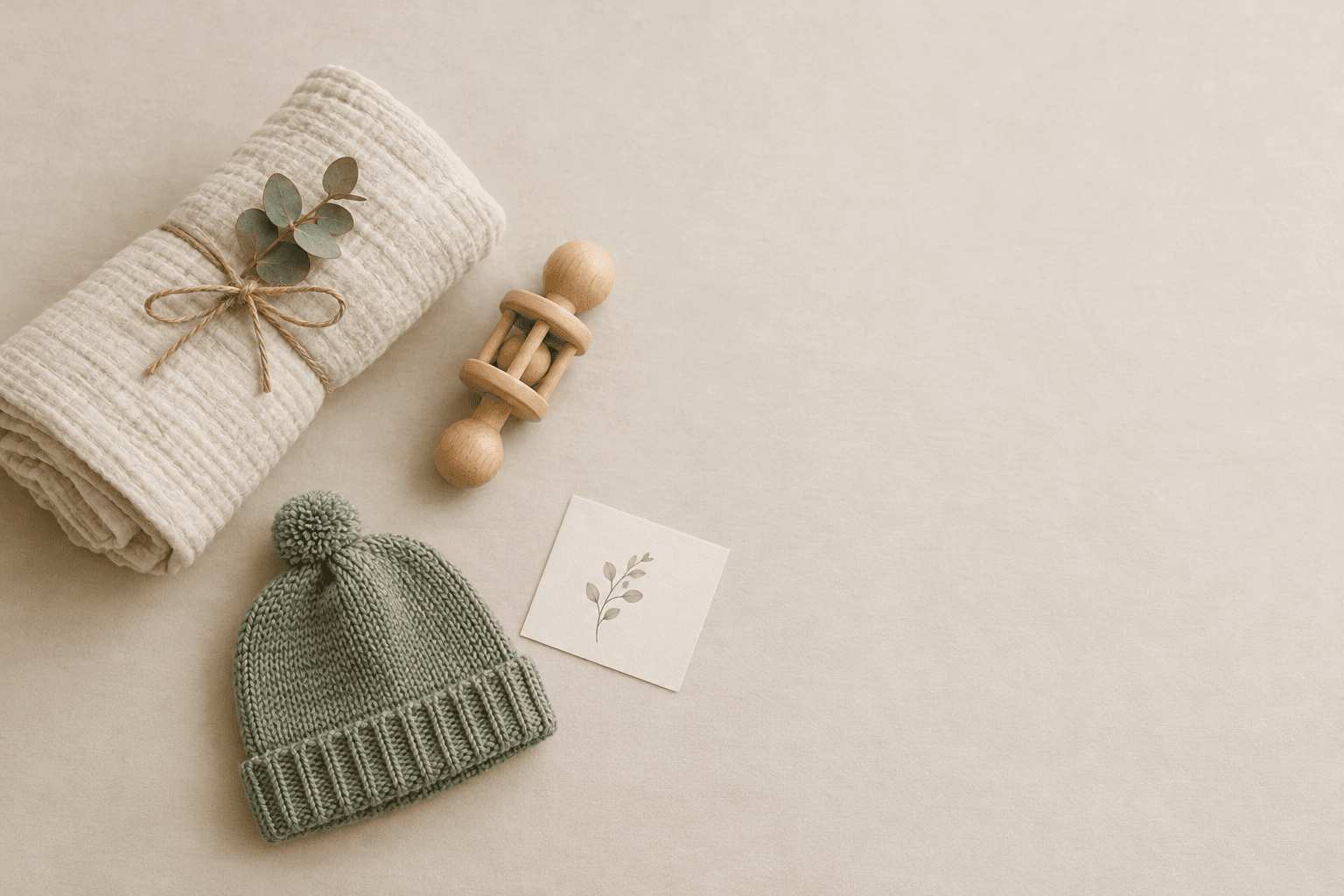
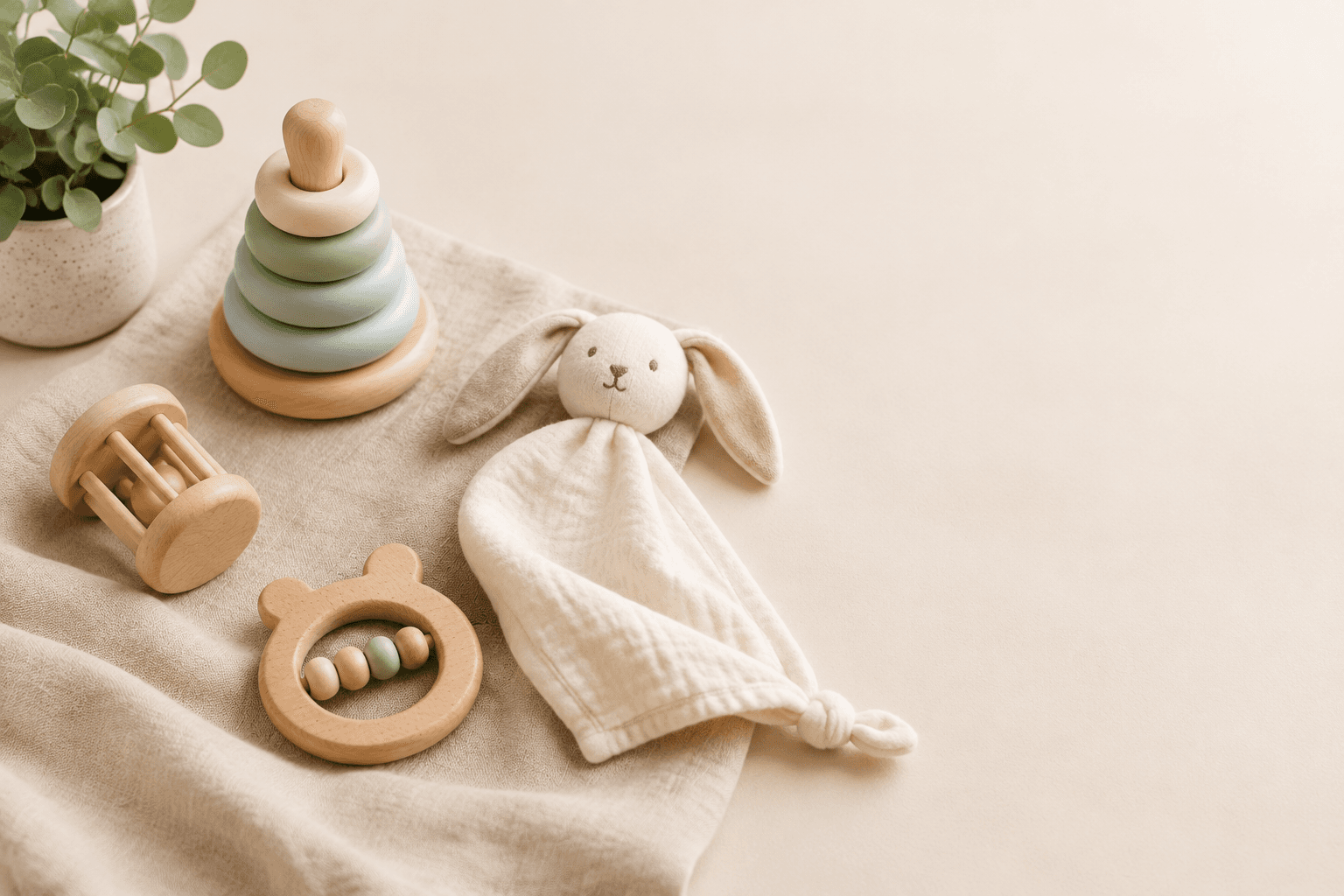
<p><img src="https://www.usescribe.io/public-assets/blog-images/internal/wooden-and-handmade-toys-for-baby-s-first-year-local-picks/bc043c7c-de69-49be-a1cc-fe9deb7d0ebf.png" alt="Illustration: Warm, uncluttered flat-lay of a few handmade baby toys (wooden ring, cotton bunny, stacking cups) on a soft neutral blanket, calm pastel palette, suitable as a header image for Wooden and Handmade Toys for Baby's First Year: Local Picks"></p>
<p>You don't need a mountain of toys for your baby's first year. A small set of well-made wooden and handmade baby toys, matched to each stage, will usually serve you better than a room full of plastic and batteries. This guide covers what to look for at 0 to 3 months, 4 to 8 months and 9 to 12 months, how to check that an artisan toy is safe, how to look after it, and how to add your favourites to a local baby registry.</p>
<p>A quick note on who this is for: I'm writing for South African parents and gift-givers, so the shops, standards and prices below are South African. If you're reading from the UK or elsewhere, the safety principles still apply, but check the toy-safety rules and markings where you live. For example, toys sold to consumers in the UK need to meet UK toy safety regulations. I've grouped the guide by stage rather than month by month, because babies don't read calendars. ☕</p>
<p>If you're a first-time mum or dad staring at an endless scroll of rattles, mobiles and flashing gadgets, take a breath. Choosing handmade baby toys is simpler than it looks.</p>
<h2>Why Simple Handmade Baby Toys Work 🌱</h2>
<p>Picture this. Someone gifts your baby a shiny electronic toy with lights, songs and three buttons. Your little one gives it a quick glance, then happily gnaws on a wooden spoon from the kitchen drawer. If that sounds familiar, you're not doing anything wrong. It makes a lot of sense.</p>
<p>Babies learn through touch, mouthfeel, weight and sound. A toy that does one simple thing leaves room for your baby to do the rest: grab it, turn it, drop it and try again. The American Academy of Pediatrics (<a href="https://www.healthychildren.org">healthychildren.org</a>) encourages choosing toys that get children and caregivers playing and interacting together, rather than toys that do all the entertaining.</p>
<p>There's some research pointing the same way. A 2016 study in <em>JAMA Pediatrics</em> looked at 26 parent-infant pairs (babies aged 10 to 16 months) and found fewer adult words and fewer back-and-forth exchanges during play with electronic toys than with traditional toys or books (<a href="https://doi.org/10.1001/jamapediatrics.2015.3753">Sosa, 2016</a>). It's a small study, so it doesn't prove anything about every family. But it fits what many parents notice: a plain toy leaves space for <em>you</em> to join in.</p>
<h3>Practical benefits of wooden and natural-fibre baby toys</h3>
<ul>
<li>Durability: a well-made wooden toy can handle drops, chewing and toddler enthusiasm, though it still needs regular checking.</li>
<li>Hand-me-down potential: good pieces can go to a second baby, a cousin or a friend.</li>
<li>A timeless look: natural wood and cotton suit most homes, so your lounge doesn't turn into a neon playroom.</li>
</ul>
<h3>Why buy from local baby artisans?</h3>
<p>When you buy handmade baby toys from local baby artisans, you can often ask the maker directly what wood they used, how it's finished and how to look after it. If you're searching for wooden baby toys in South Africa, that conversation is one of the real advantages of buying small. Your money also stays with local businesses.</p>
<p>One caution I'll keep repeating: 'handmade' and 'natural' are lovely words, but they don't automatically mean safe. We'll go through how to check.</p>
<p>Each stage below has a short list of toy types, not a shopping spree. Think of the ages as gentle prompts rather than deadlines. The <a href="https://www.cdc.gov/act-early/milestones/index.html">CDC's milestone checklists</a> describe skills that most children (75% or more) are expected to have by a given age, so plenty of healthy babies get there a little earlier or later.</p>
<p><img src="https://www.usescribe.io/public-assets/blog-images/internal/wooden-and-handmade-toys-for-baby-s-first-year-local-picks/17bbf3a6-01f2-47eb-9082-67792d2fa89e.png" alt="Diagram: Simple horizontal timeline diagram showing 0 to 3 months, 4 to 8 months and 9 to 12 months, with one or two illustrated toy types under each stage, soft muted colours, clean modern style for Wooden and Handmade Toys for Baby's First Year: Local Picks"></p>
<h2>Handmade Baby Toys for 0 to 3 Months: Gentle Sights, Sounds and Grasping Practice</h2>
<p>Let's answer the big question first: what toys do newborns actually need? Very few. What they need most is you, your voice and your face, plus a few things to look at and listen to. Babies often start tracking objects with their eyes for a few seconds in these early months, and deliberately holding a toy comes later, so at this stage grasping is practice, not performance. Every baby is different.</p>
<p>Here's a calm little starter list:</p>
<ul>
<li><strong>High-contrast cards or a soft wooden mobile.</strong> Lovely for tummy time and as a distraction during nappy changes. A mobile is for looking at, never for touching. Hang it well out of reach, follow the maker's instructions, and take it down when your baby starts to push up on hands and knees, or around 5 months, whichever comes first.</li>
<li><strong>A lightweight wooden or fabric rattle</strong> with a soft, gentle sound. Use it briefly while you're right there, and keep hard toys away from your baby's face when they're lying on their back. Your baby will grow into holding it.</li>
<li><strong>A handmade soft cloth toy or comforter</strong> in natural fibres, for supervised cuddles while baby is awake. Keep it out of the cot at sleep time, as soft objects and toys don't belong in the sleep space. This matters even more with handmade pieces that might have ties, loops or decorations.</li>
<li><strong>A simple, one-piece wooden grasping ring</strong> for first attempts at holding things, offered briefly with your help. Some babies show interest around 2 to 3 months, and others take longer.</li>
</ul>
<p>These toys sit happily alongside the practical newborn essentials most parents put on a baby registry: blankets, muslins, nappies and sleepwear. I'd mix both. A registry with only toys looks lovely, but a registry with only nappies feels a bit flat. A blend gives guests something fun to pick.</p>
<h2>Handmade Baby Toys for 4 to 8 Months: Mouthing, Reaching, Rolling and Sitting 🪵</h2>
<p>This is where things get busy. Around 4 months many babies swing at toys, bring their hands to their mouths and hold what you place in their hands. By 6 months many are reaching to grab things and propping themselves up to sit. And yes, <em>everything</em> goes in the mouth.</p>
<p>Try to see mouthing as learning, not mess. It's how your baby gathers information about shape, texture and temperature. It also means safety checks matter a little more now.</p>
<h3>What to look for in wooden and handmade baby toys</h3>
<ul>
<li><strong>Teethers.</strong> Makers often use hardwood such as beech or maple, or natural rubber, finished with food-grade oils or waxes. A food-safe finish doesn't on its own prove a toy is safe to chew, so only use a toy as a teether if the maker designed and tested it for that, and ask what testing it has had.</li>
<li><strong>Lightweight wooden rattles and grasping toys</strong> that are easy for small hands. Choose light, smooth, age-appropriate pieces and stay close, especially when your baby is lying on their back and could drop a toy onto their face.</li>
<li><strong>Stacking rings, nesting cups and simple blocks.</strong> These start the cause-and-effect game, including the pure joy of knocking things over. Check that every piece is too big to be a choking risk.</li>
<li><strong>Soft handmade balls or crinkle books</strong> for rolling and reaching during tummy time. Choose larger ones and avoid small rolling objects that could become a choking hazard.</li>
<li><strong>A few chunky, easy-to-grab toys within reach</strong> while your baby practises sitting, rather than a big pile.</li>
</ul>
<p>My tip: rotate two or three toys at a time and tuck the rest away. Each one feels new again when it comes back out.</p>
<h3>Comparing materials for baby toys</h3>
<p><img src="https://www.usescribe.io/public-assets/blog-images/internal/wooden-and-handmade-toys-for-baby-s-first-year-local-picks/85bad828-4889-4318-b7c8-61510375fea3.png" alt="Comparison: Clean comparison table graphic in soft neutral colours comparing baby toy materials (hardwood, softwood, natural rubber, organic cotton) across durability, teething suitability and care needs, with simple icons for Wooden and Handmade Toys for Baby's First Year: Local Picks"></p>
<table>
<thead>
<tr>
<th>Material</th>
<th>Good to know</th>
<th>Care notes</th>
<th>Teething?</th>
</tr>
</thead>
<tbody><tr>
<td>Hardwood (e.g. beech, maple)</td>
<td>Dense and durable, smooth when well sanded</td>
<td>Wipe clean, don't soak, follow the maker's advice on re-oiling</td>
<td>Only if the maker designed it for teething</td>
</tr>
<tr>
<td>Softwood (e.g. pine)</td>
<td>Lighter and often cheaper, but dents and scratches more easily</td>
<td>Inspect more often for splinters and chips</td>
<td>Ask the maker; not usually first choice</td>
</tr>
<tr>
<td>Natural rubber</td>
<td>Soft and squeezy, which many babies love</td>
<td>Follow the maker's cleaning advice and avoid long sun exposure</td>
<td>Often, if sold as a teether</td>
</tr>
<tr>
<td>Organic cotton</td>
<td>Cuddly and washable, good for comforters and soft balls</td>
<td>Check stitching is secure; wash gently per the care label</td>
<td>Not designed for teething</td>
</tr>
</tbody></table>
<p>These are general notes. The maker's care instructions and intended-use guidance always come first.</p>
<h2>Handmade Baby Toys for 9 to 12 Months: Crawling, Pulling Up and Problem-Solving</h2>
<p>Now your baby is on the move: crawling, pulling up on the coffee table, passing things from hand to hand, and slowly working out that a toy still exists when it's hidden under a cloth. Play gets more purposeful, and toys can become small challenges. 🧩</p>
<ul>
<li><strong>Stable push-along wooden toys.</strong> These can support early cruising, but check that they're sturdy, use them on a safe floor and stay close. I'm not talking about seated, wheeled baby walkers, which the American Academy of Pediatrics advises against. And a toy is never a substitute for secure furniture or supervision.</li>
<li><strong>Wooden shape sorters, chunky puzzles with big knobs, and stacking toys.</strong> Large nesting cups and simple containers with oversized objects are perfect for the 'put it in, tip it out' phase.</li>
<li><strong>Simple musical toys.</strong> Fabric or wooden shakers and small drums are great for exploring rhythm and cause and effect. If you add a xylophone or drum with a mallet, choose one labelled for your baby's age, with a chunky, securely attached mallet, and stay close while they play.</li>
<li><strong>Handmade soft dolls, animals and fabric books</strong> for first imaginative play and bedtime routines (cuddles before sleep, but not in the cot).</li>
</ul>
<p>And here's the reassuring bit: at this age, simple still wins. A basket of safe everyday objects plus two or three artisan favourites will see your baby comfortably to their first birthday.</p>
<h2>Safety Checklist for Handmade and Wooden Baby Toys ✅</h2>
<p>Are wooden toys safe for babies? They can be, when they're well made and age-appropriate. Handmade baby toys need the same careful checks as any other. You don't need to be an expert, just curious.</p>
<p><img src="https://www.usescribe.io/public-assets/blog-images/internal/wooden-and-handmade-toys-for-baby-s-first-year-local-picks/abc19ed4-5ea4-4ef5-98a4-b2342e4881ff.png" alt="Infographic: Friendly infographic checklist with seven numbered icons covering size, smooth finish, non-toxic finish, safety standards, construction, age match and regular checks, in a calm pastel palette suitable for a baby brand for Wooden and Handmade Toys for Baby's First Year: Local Picks"></p>
<ol>
<li><strong>Check size and shape.</strong> A common rule of thumb is that nothing should be small enough to fit through a toilet roll tube, and there should be no parts that can come loose, including beads, buttons, bells and wheels. Treat this as a quick home check, not a replacement for the maker's age labelling and testing.</li>
<li><strong>Feel the finish.</strong> Surfaces should be smooth, with no splinters, sharp edges or rough spots, and corners should be rounded.</li>
<li><strong>Ask what's on it.</strong> Ask the maker about paints, oils, waxes and glues, and look for finishes intended for children's products. Good artisans love this question. Labels like 'non-toxic' or 'food-safe' aren't proof on their own, so ask what the finished toy was tested against.</li>
<li><strong>Ask about testing and standards.</strong> Reputable makers should be able to explain how their toys meet safety requirements. You may hear about EN 71, the European toy-safety series, or SANS 8124, the South African toy-safety series. Compulsory requirements for toys in South Africa are administered by the <a href="https://www.nrcs.org.za">National Regulator for Compulsory Specifications (NRCS)</a>, so ask for documentation for the specific product and check current requirements rather than relying on a general safety claim. In the UK, check the applicable toy safety requirements and markings for the product.</li>
<li><strong>Look at construction.</strong> Check for strong joins and secure stitching on fabric toys. Avoid long cords, loops or ribbons, and be wary of accessible magnets or button batteries.</li>
<li><strong>Match the toy to the age.</strong> Read the maker's age guidance and follow it. A toy that suits a nine-month-old may not suit a newborn, and supervision still matters.</li>
<li><strong>Re-check regularly.</strong> Look for cracks, chips, peeling finish, loose parts or wear, especially after a toy has been chewed, dropped or washed. Retire anything that looks tired.</li>
</ol>
<h3>Questions to ask local baby artisans</h3>
<p>Screenshot this little list for your next shop visit or message:</p>
<ul>
<li>What age is this toy designed for?</li>
<li>Is it designed and tested for mouthing or teething?</li>
<li>What wood or fabric and which finish did you use?</li>
<li>Are the parts mechanically secured?</li>
<li>How should I clean and care for it?</li>
<li>Can you share test or compliance information for the finished toy?</li>
</ul>
<p>A clear, friendly answer tells you a lot. If a maker can't answer, that tells you something too.</p>
<h2>How to Clean and Care for Wooden Baby Toys 🧼</h2>
<p>How do you clean wooden toys? Gently. Wood doesn't like soaking, so skip submerging it, running it through the dishwasher or leaving it to bake in the sun. Always check the maker's care instructions first, as finishes differ.</p>
<ol>
<li><strong>Wipe</strong> with a soft cloth lightly dampened with water and a little mild soap.</li>
<li><strong>Rinse-wipe</strong> with a clean damp cloth.</li>
<li><strong>Air dry</strong> fully before it goes back in the toy basket.</li>
<li><strong>Go deeper only if the maker says it's okay.</strong> Some makers suggest diluted white vinegar on a cloth, but not every finish tolerates it, and disinfectants or alcohol products may not suit wood either.</li>
<li><strong>Re-oil only as the maker recommends.</strong> Some finishes need occasional re-oiling, others don't, so ask which product they suggest.</li>
<li><strong>Care for fabric toys</strong> by following the care label, using a gentle detergent and air drying. Hand-wash delicate handmade pieces.</li>
</ol>
<p>My tip for sick days and after playdates: keep a small 'toys to clean' basket. Anything that's been heavily mouthed or shared goes in there, so you're not scrambling. And when you buy from a local artisan, ask for the care instructions in writing and keep them with the toy.</p>
<h2>Do You Need Lots of Handmade Baby Toys in the First Year?</h2>
<p>No. Most babies are just as happy with a handful of well-chosen toys as with a whole shelf.</p>
<p>Here's a made-up but realistic picture. Imagine a parent, let's call her Thandi, who spends her pregnancy convinced she needs everything, so her baby's room fills up fast. By month six she notices her daughter keeps returning to the same three things: a wooden ring, a soft cotton bunny and, yes, a wooden spoon. Thandi isn't a real person, but many parents describe something similar, and it's a good reminder that your baby's attention is simple.</p>
<p>Here's a gentle starter set for the whole first year:</p>
<ul>
<li>One or two teethers or grasping rings (designed for the purpose)</li>
<li>One rattle</li>
<li>One soft toy or comforter</li>
<li>A stacking or nesting toy</li>
<li>One stable push or pull toy by the end of the year</li>
</ul>
<p>Then rotate. Keep a few toys out, store the rest, and swap every week or two. Fewer toys mean less clutter and more focused play, and you'll be glad of the extra floor space when your baby starts crawling. It's also perfectly fine to tell family, 'we're keeping things simple.' A registry makes that conversation easy.</p>
<h2>Adding Handmade and Wooden Baby Toys to Your Baby Registry 🎁</h2>
<p>Toys make lovely baby shower gifts. They're easy for guests to choose, and they feel special when they come from local artisans. The trick is avoiding five identical rattles.</p>
<p>Everything above applies wherever you shop. Check the age guidance, ask the safety questions and look at the finish. Once you've found makers you trust, you need somewhere to collect them. As part of the bababloom team, I'll be upfront that this is the part where I tell you about our own platform, so I'll keep it factual.</p>
<h3>How bababloom works</h3>
<p>bababloom is a baby registry platform built around local South African baby stores and artisans, so you can add products from lots of different shops into one shareable registry.</p>
<ul>
<li>No duplicate gifts: guests can see what's already been chosen.</li>
<li>Familiar checkout: guests buy directly on the retailer's own website, so it feels just like shopping with that store.</li>
<li>Free to build: you create your registry for free and pay a once-off R199 when you're ready to share it. Check the bababloom site for current pricing.</li>
<li>Plenty of variety: our live example registry has 102 gifts from 31 stores, which shows how varied a registry can be.</li>
</ul>
<p>bababloom doesn't vet individual toys for safety on your behalf, so the checklist above still applies to anything you add. Ask each store or maker the questions before you add a toy.</p>
<h3>Building a balanced baby registry</h3>
<p>Aim for a few toys per stage, plus newborn essentials like sleep, feeding and nappy items, so guests at every budget have options. For example, you might pair:</p>
<ul>
<li>a wooden grasping ring or soft cloth comforter for the newborn stage,</li>
<li>a set of stacking cups for the 4 to 8 month stage,</li>
<li>a stable push-along toy or fabric book for the 9 to 12 month stage,</li>
<li>and a muslin set or two from the practical essentials.</li>
</ul>
<h3>Giving back with the Hatch Foundation</h3>
<p>bababloom also partners with the Hatch Foundation, so guests can donate a R500 Hatch Bag of newborn essentials to a mum in need. It's a lovely option for the guest who'd rather give back than add another toy to the pile.</p>
<h3>Friends and family abroad</h3>
<p>Your aunt in London or friend in Perth can still be part of it, because you can share your registry link with anyone. Each gift is bought from the retailer's own site, though, so whether a particular shop delivers internationally depends on that store. It's worth checking before they buy.</p>
<p>Ready to start? Create a free registry and add your first handmade toy. You can always add more later. 🌸</p>
<h2>Frequently Asked Questions About Handmade Baby Toys</h2>
<h3>Are wooden toys safe for babies?</h3>
<p>They can be, as long as they're well made and suited to your baby's age. Look for smooth finishes, rounded edges and no small or loose parts. Ask the maker about materials, finishes and testing, and remember that a 'non-toxic' or 'food-safe' label alone doesn't prove a toy is safe to chew. Check toys regularly for cracks or splinters.</p>
<h3>What toys do newborns need?</h3>
<p>Very few. In the first three months, babies enjoy high-contrast images, gentle sounds and, when you're close by, a simple grasping ring or soft toy. Your voice and your face are the best toys at this stage.</p>
<h3>How do I clean wooden toys?</h3>
<p>Wipe them with a damp cloth and a little mild soap, then wipe again with clean water and let them air dry. Don't soak them or use the dishwasher. Follow the maker's care instructions, including their advice on re-oiling.</p>
<h3>Do I need many toys in the first year?</h3>
<p>No. A small set matched to each stage is plenty, and rotating a few toys keeps play fresh. Quality matters more than quantity.</p>
<h3>How can I tell if a handmade toy is well made?</h3>
<p>Check that joins and stitching are strong, surfaces are smooth, and the maker is happy to explain their materials, testing and age guidance. Trust your instincts: if something feels rough, flimsy or has parts that could come loose, leave it.</p>
<h3>Can I put handmade toys from different local stores on one registry?</h3>
<p>Yes. With bababloom you can add products from different South African baby stores and artisans into one registry, and your guests buy directly from each retailer's own site.</p>
B
Baba Bloom Team
Author